


オルクログ BLOG
2026.10.21
How Many Channels Can Be Used on the Same Site, and How to Record Audio When the Signal Drops
Up to How Many Channels for UWP-D11? Proper Use of B-Band and 1.2GHz A-Band Digital
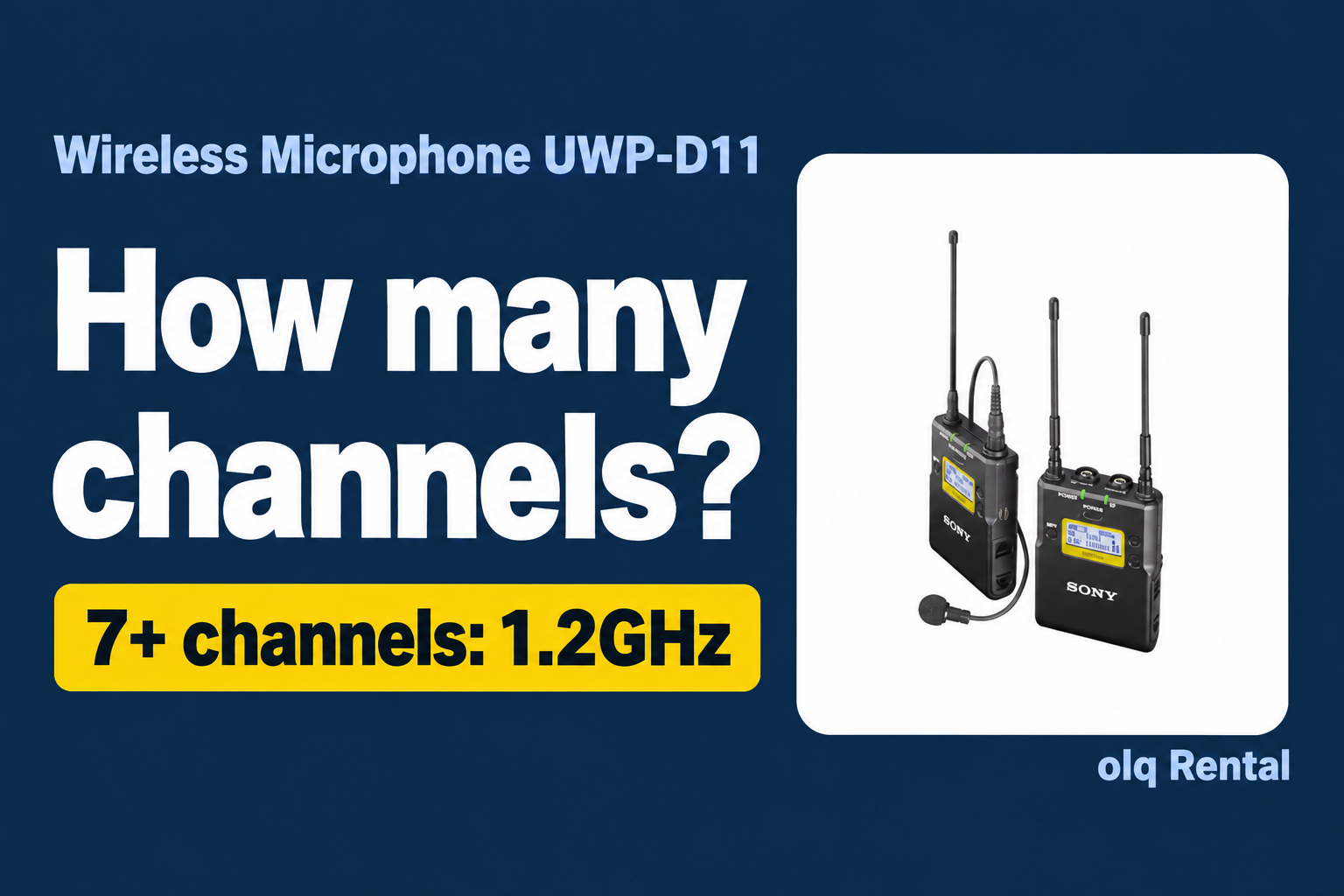
The most common inquiry regarding wireless microphones is, "How many channels can be used simultaneously on the same site?" The answer is determined not by the sheer number of channels, but by the frequency band of the radio waves being used. Furthermore, measures to preserve audio when a signal drops can be incorporated in advance.
What you will learn in this article:
- The upper limit and frequency assignment procedure when using license-free B-band wireless microphones in the same space.
- The decision to switch to 1.2GHz A-band digital for sites with 7 or more channels, and the deadline for usage applications.
- How to use a recorder inserted before the transmitter to retain audio even if the radio signal becomes unstable.
Conclusion: B-Band for up to 6 channels, 1.2GHz A-Band Digital for 7 or more channels
Olq's B-band wireless microphones (UWP-D11 Set・UWP-D21 Set)support license-free frequencies in Japan's B-band = 806.125 to 809.750 MHz. Since neither a license nor notification is required, there is no waiting time for procedures, even for shoots or interviews the next day.
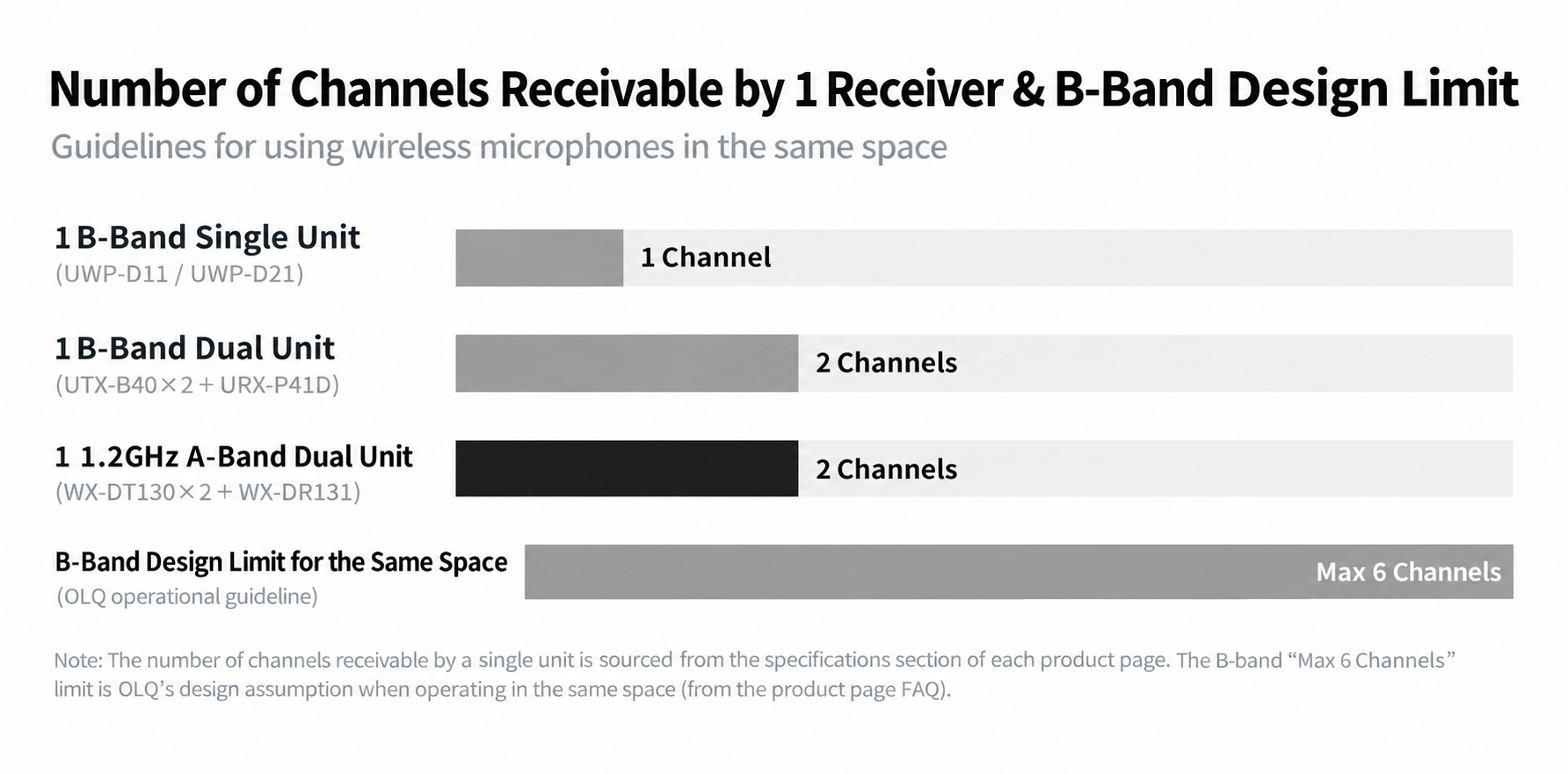
However, when using multiple units in the same space, assignment design is necessary. At Olq, we design for a maximum of 6 channels, determine frequencies through column combinations of channel plan groups, and reconfigure with another group if interference occurs. For sites planning 7 or more channels, we propose switching to commercial 1.2GHz band wireless or a non-RF lavalier microphone recorder (from the FAQ on the UWP-D11 set product page).
When estimating, substituting the required number of units with the number of receivers prevents mistakes. A B-band single set provides 1 channel per receiver, a B-band dual set provides 2 channels per receiver, and a 1.2GHz A-band digital dual set provides 2 channels with 2 transmitters and 1 receiver. The numbers in the figure above are all taken from the specifications section of each product page.
B-band UWP-D11 and UWP-D21:Differences and On-site mounting

Both are B-band sets, but from different generations with differences in specifications. Since the frequency band, license handling, transmission output, and continuous operation time are the same, we list only the items that differ from the product page specifications.
| Item | UWP-D11 Set | UWP-D21 Set |
|---|---|---|
| Transmitter・Receiver | UTX-B03・URX-P03 | UTX-B40・URX-P40 |
| Max Channels | 30ch(125kHz spacing) | Up to 16ch |
| Sync Settings | Infrared IR Sync | Infrared IR Sync and NFC Sync |
| External Power | Receiver supports USB external power | Both transmitter and receiver support USB Type-C |
Let's also talk about mounting. Both sets arrive with a shoe mount adapter attached to the receiver, so they are built assuming placement on a camera accessory shoe. If you want to connect directly to a Sony camera's MI shoe, a compatible adapter like the SMAD-P5 is required. Connection and mounting are two different things, so if you let us know your camera model, we can verify the mounting compatibility as well.
Transmission distance varies by environment. At Olq, we use an effective distance of about 10 to 100m as a guideline, 30 to 50m for tree-dense outdoor areas, and 50 to 70m for open spaces (from the UWP-D21 set FAQ). Please do not skip the pre-production communication test.
1.2GHz A-Band Digital for Sites with 7+ channels or where interference must be avoided

The 1.2GHz A-band digital wireless microphone dual set consists of two WX-DT130 transmitters and one WX-DR131 receiver. The 1.2GHz band A-type requires a usage application and cannot be used without it. Please fill in the remark’s column by 2 business days prior to your usage date with: (1) Date and time of use (month, day, day of the week, time slot), (2) Address of the location, and (3) Information of the onsite person in charge. While it adds a step, as stated on the product page, it offers higher safety and stability than the B-band.
Settings are chosen according to the site. WIDE has a bandwidth of 288 kHz and a latency of approx. 1.1 msec, ideal for sites with fewer channels where sound quality is prioritized. NARROW compresses the bandwidth to 192 kHz with a latency of approx. 2.9 msec, allowing more units to be used while enhancing performance against noise and dropouts from momentary pulse interference. Transmission output can be selected from 20mW, 10mW, and 2mW; increasing it allows greater distance from the receiver, but a high number of simultaneously used units increases the risk of interference.
The WX-DR131 receiver can be operated slung over the shoulder with a shoulder strap. Dedicated antennas for the 1.2GHz and 800MHz bands, two lavalier microphones, windscreens, 8 eneloop pro batteries, and a frequency chart are all included. For long shoots or stationary setups, adding a power adapter for the WX-DR131 eliminates battery concerns for the receiver.
Retaining audio even when signal drops: The insurance of DR-10C [RAMSA Specification]

Even with 1.2GHz A-band approved via application, as long as radio waves are used, the possibility of an unstable connection due to walls or distance remains. That is where the DR-10C [RAMSA Specification] comes in. It is a recorder used and inserted between a RAMSA lavalier microphone and a 2-piece transmitter. By simply connecting it to the WX-DT130 using the included transmitter connection cable, it transmits audio wirelessly while simultaneously recording the exact same audio onto an internal microSD card. Because the path passed to the transmitter and the internal recording circuit are independently designed, the recording is preserved even if audio drops out on the wireless side. On sites with radio signal concerns, you can secure an insurance policy without adding a single radio channel.
The recording format is mono WAV/BWF at 48kHz/24-bit, and the recording media is microSD/microSDHC up to 32GB (a 32GB card is included). Power is supplied by a single AAA battery, with a continuous operation time of approx. 10 hours with alkaline and approx. 15.5 hours with lithium. Since it runs longer than wireless transmitters or receivers, the insurance side won't run out of power first. The unit arrives with a belt clip attached, measuring 52 × 55.6 × 24.4 mm and weighing approx. 63g with a battery. Whether bundled with a transmitter or worn side-by-side on a belt, it is compact. It also features dual-level recording (recording two levels simultaneously to prevent clipping from loud sounds), auto-gain, limiter, and low-cut filters.
Because TASCAM's genuine combination (DR-10C and AK-DR10CR) was discontinued, this product is a semi-original item in which Olq manufactured the connector plate portion. The section that functioned as either IN or OUT on the genuine version has been made completely independent, prioritizing durability for the RAMSA specification only. In December 2025, it was updated to a voltage-through structure, allowing it to be used with just the wireless microphone even when the DR-10C main unit is powered off. It is commonly rented together with the 1.2GHz A-band digital dual set.
DR-10C and DR-10L have different uses
Even with TASCAM's DR-10L, you can back up audio, but their roles are different. The DR-10L is a lavalier recorder that records the subject's voice directly to an internal microSD card without using radio waves, meaning you cannot monitor the audio during recording. The DR-10C is inserted between the lavalier mic and the wireless transmitter, so audio reaches the receiver as well, allowing you to monitor while recording. If your priority is to record each person reliably without increasing radio channels at the venue, choose the DR-10L. If you want to monitor the audio wirelessly while keeping a safety backup, choose the DR-10C.
Setting up a 6-channel site (A combination example)
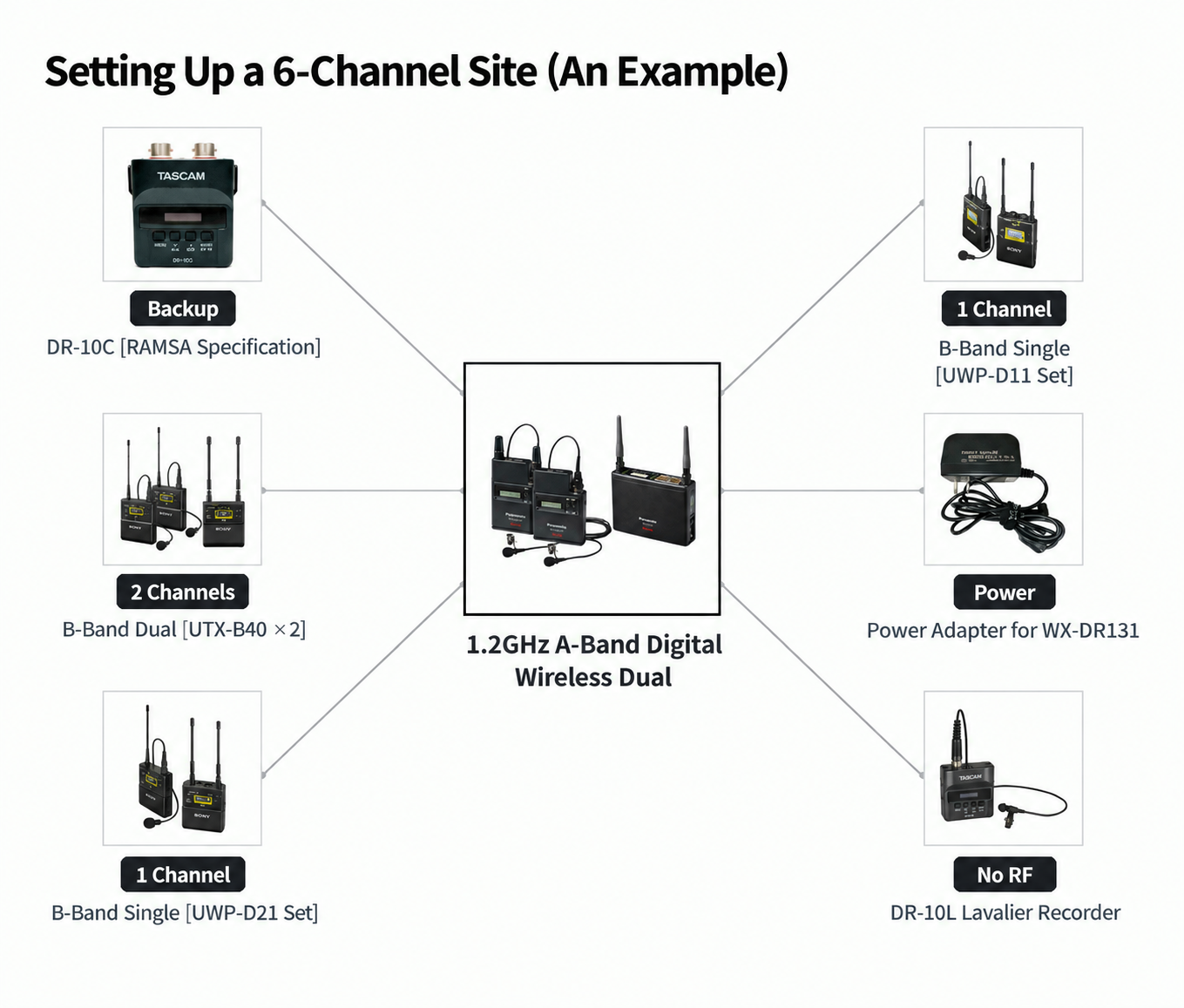
If you are setting up a site with 6 presenters using Olq’s inventory, it would look like this: Start with the primary 1.2GHz A-band digital dual set for 2 channels. Add a B-band dual set for 2 channels, plus one UWP-D21 set and one UWP-D11 set (1 channel each), bringing the total to 6 channels. Since the B-band side is kept to 4 channels, there is still plenty of margin within our 6-channel maximum design framework. This setup requires 4 receivers, so counting your input count in advance is key. Another option is assigning a DR-10L to anyone in a position where you do not wish to add more radio frequencies.
Receivers run out of battery first (approx. 4 to 8 hours)
According to catalog specifications, the B-band UWP-D11 set transmitter lasts approx. 8 hours, and the receiver lasts approx. 6 hours (on alkaline batteries). For the 1.2GHz A-band, the WX-DT130 transmitter lasts approx. 7 hours (Ni-MH) / approx. 5 hours (alkaline), and the WX-DR131 receiver lasts approx. 6 hours (Ni-MH) / approx. 4 hours (alkaline). In any combination, the receiver runs out of battery first, so plan your shooting duration around the device with the shortest battery life. If shooting exceeds 8 hours, spare batteries are essential. Replacing the included eneloop batteries with non-rechargeable AA lithium batteries extends operating time by about 1 to 3 hours, and the receiver side can also be powered using an AC power adapter. All numbers are catalog values from each product page’s specifications and FAQ sections, and may vary depending on settings such as RF output power.
Equipment introduced in this article
- 1.2GHz A-band digital wireless microphone dual [WX-DT130×2 ,WX-DR131×1]
- DR-10C [RAMSA Specification]
- B-band wireless microphone single [UWP-D11 set]
- B-band wireless microphone single [UWP-D21 set]
- B-band wireless microphone dual [UTX-B40 x2+URX-P41D]
- SMAD-P5 [For URX-P40,URX-P41D][Compatible with UWP-D21,D22]
- Power adapter for 1.2GHz A-band [RAMSA WX-DR131]
- DR-10L
How many channels do you need? How many hours will you shoot? Where will the receivers be mounted? Do you need dual/backup audio recording?
Deciding these four factors in advance will eliminate virtually all rework on set. If you are unsure, simply let us know the number of people on set, shooting duration, and camera models you are using. We will gladly assist you in choosing the right frequency bands.